For my 2018 sabbatial, I set up created an experience with a mobil studio in my van and headed west. Here is the story in the form of a video exported from pdf presentation.
Tag: 1910
-
An Experience of May 25, 1910 on May 4, 2015
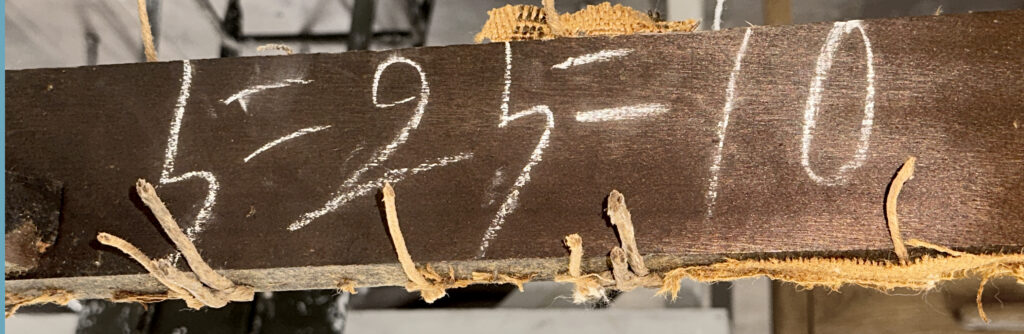
May 25, 1910: Deconstruction/Reconstruction
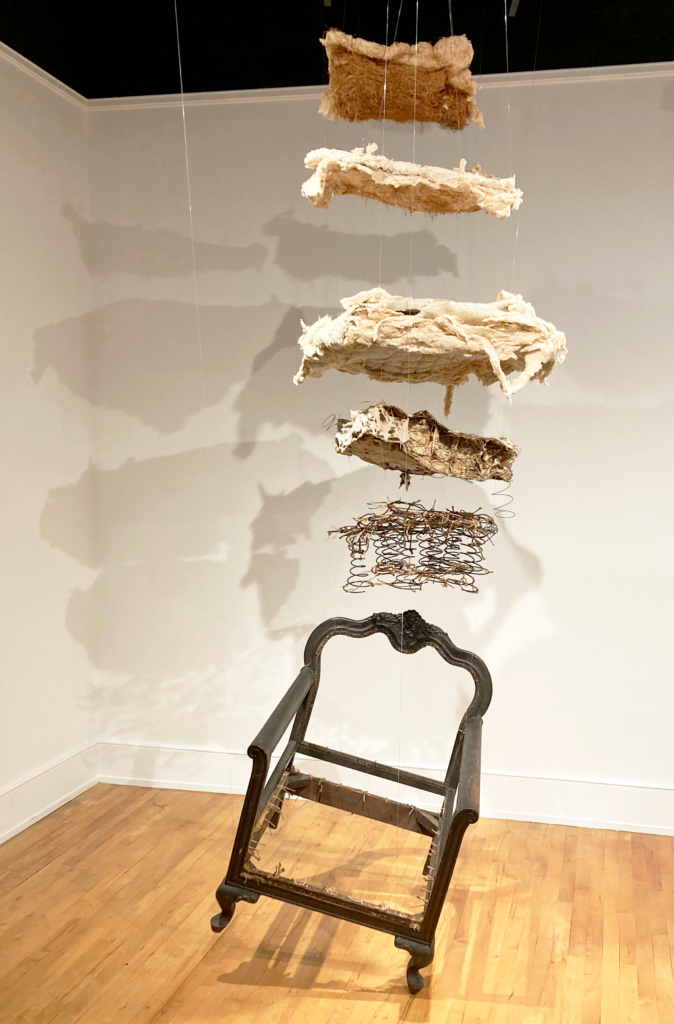
(2023)
36’’ x 36’’ x 52’’
Mixed Upholstery MaterialsThis chair has been in the Dana Fine Arts building for at least 30 years — since I started teaching-. We tend to accumulate stuff here, people donate furniture, books, or supplies; students leaving things behind; teacher’s accumulations for still lives and for models, so the provenance of any particular item is hard to know, of course, mostly it doesn’t matter. This chair had been part of drawing setups for years. It had tape all over it to mark model positions during breaks so they could resume their post, scuffs, paint and loss of lustre as happens to objects in studio environs. For years it found its way to a corner on the ground floor to be filed into a next life. Prop storage and / or dumpster or donation. As I investigated it to deconstruct it for recycling, I became engaged in its original construction, which involved various layers of materials and NO PLASTIC. This led me to gingerly take it apart–out of curiosity for the construction process and out of respect for the traditional craft and wholesome materials. And so began our relationship. I fell in love with the skills of craft the work–seven layers wrapped, sewn, and trussed, materials of all cotton batting in finely spun muslin casings, tied with short lengths of jute cord. Traces of iron rust formed rings of color documenting the the years of contact between the springs and their casements. I laid the pieces out as I took them apart, eventually illustrating the work in a reverse design schematic in an exploded view of sorts. The care of craft with the various materials made me care about it too. No plastic? An unthinkable idea for 21st century American production. I am effected by the value of designing an object with care for its longevity, making something that might outlast the maker’s lifetime. It’s the same ethos an architect has for the lifetime of a building. There’s a generosity in it that feels right to me. As I got down to the lower inside frame of the structure, I noticed what has to be a date on a cross bar. It has the kind of handwriting typical of people trained in long-hand — the curly start and stop of the number 2. To corroborate my theory that the markings “5-25-10″ referenced the date (May 25, 1910” I researched furniture manufacturing in 1910, and this construction is consistent with the standards and materials of the time.
Provenence:
Rescue: Waste and Redemption
4.6 — 6.15.2024, Lizzie Zucker Saltz, curator
Link to the Exhibition CatalogLooking Back: New and Revisited Works by Nell Ruby
March 2026,Looking Out
“I love the idea of redemption through transformation, and how the artists in RESCUE embody that kind of material alchemy.” – Lizzie Zucker Saltz, Curator.
Selected artists: Adah Bennion, Paul Blake, Lisa Freeman, Heather Bird Harris, Susan Lenz, Casey McGuire, Larry Millard, Zachary Naylor, Johanna Norry, Emily Peters, Pilar, Paula Reynaldi, Nell Ruby, Lisa Schnellinger, Lenore Solmo, Kelly Thompson, Gregor Turk, Jon Vogt, Michael Webster, Matthew White, Kelsey Wishik and Joni Younkins.
Guest Curator Saltz believes that “Rescue’s twenty-four artists’ will heighten audiences’ awareness of these core environmental issues.”
Nell Ruby’s 5.25.1910: Deconstruction/Reconstruction presents us with a 3-D recreation of an exploded chair diagram, as if it was in the process of being manufactured, but in reverse. We are used to seeing the image of a product design in an exploded view, but those predict the future not the past, which adds a surreal layer to her installation. (Most new products have no Cradle-to-Grave plan, not to mention a Cradle-to-Cradle Certification stamp; hopefully we will see this change. Cradle-to-Cradle Certification is given to products and systems that mimic nature and are efficient, fair, and waste-free.33 Ruby shows us a product in an exploded view at its death, using its actual materials. The artist came upon the idea when breaking down a chair for disposal and catching sight of its date of manufacture; ‘5.25.1910.’ She soon gained an appreciation of each turn-ofthe-century part, most of which could be reused or recycled. This is in contrast to most of today’s ‘fast furniture,’ whose components often include off-gassing foam and un-recyclable fiber board held together by a formaldehyde glue. Ruby writes that she “Was taken by the care of craft of its assembly and primarily by use of materials that involved tying, trussing, wrapping, packing wrapping and NO plastic; its baton had so organically—almost lovingly taken on the impression of the springs that it encased, that I became gentle with the rest of my deconstruction, and discovered layer by layer a beauty and integrity to the whole.” Sharing her love-affair with this handsome chair provides us with an anecdote that encapsulates a century of manufacturing change, away from reusable components and towards landfilling pollutants. Hopefully we will see a move toward closed-loop economies. When you shop, look for wood furniture made from reclaimed wood and from wood certified by the Forest Stewardship Council or the Sustainable Forestry Initiative.